Free Online Google Keyword Research Tool.
Update 2.3: Moving from a maximum of 100 keyword suggestions to 50 by the first of June.
Online search starts with either a keyword, keyword compbination or a prompt. This can be, by simply typing in your keyword into the Google search box or by prompting AI like ChatGPT, Gemini or Claude. Based on the user input the most relevant results are returned to answer the query. Optimizing your content and ranking for the right keywords and prompts, determines the success of your website and your online business.
To help you discover the right keywords and to create successful online content, we’ve build the free Keyword Research Tool. Find out how your customers use search to orientate, compare and buy your product or service online.

What others say about this tool..



The SEO Review Tools Keyword Research Tool is great when you’re in a pinch. I love using it on mobile when I’m on the go and have an idea, or I’m checking a content idea for friends.
This is a great tool to have in your back pocket for clients or to quickly sanity check search volume for a particular keyword.
Tommy Griffith — Co-Founder ClickMinded
How to do keyword research for SEO & LLM optimization?
To optimize for both traditional search engines and AI-driven Large Language Models (LLMs), you should combine keyword research with topic, intent, and entity-based optimization. Our keyword tool can help you build the foundation for both.
- Step 1: Build your core keyword list
Start by using your keyword tool to collect all relevant keywords for your business. Focus on core search terms that represent your products, services, and main topics. - Step 2: Expand into related keywords and questions
Use the tool to find keyword suggestions, synonyms, and long-tail variations. For LLM optimization, also pay attention to question-based queries (what, how, why, best way to…).
Additional tool → Question generator - Step 3: Group keywords into topics and intent clusters
Instead of treating keywords individually, group them into themes. Each cluster should represent one clear topic or user intent that can become a dedicated page or content hub.
Recommended tool → Keyword grouper - Step 4: Assign focus keywords to pages
Use your keyword data (search volume, competition, and relevance) to assign a primary focus keyword per page. This remains essential for SEO, while supporting clear topic targeting for LLMs. - Step 5: Enrich pages with supporting keywords and entities
Add related keywords, search suggestions, synonyms, and industry entities naturally within the content. This helps search engines and LLMs understand context and topical depth. - Step 6: Create content that answers questions directly
Use your keyword research (especially question-based keywords) to structure content that clearly answers user intent. Include definitions, steps, examples, and FAQs to improve AI readability. - Step 7: Publish, structure, and optimize for discoverability
Ensure content is well-structured with clear headings, logical flow, and clean HTML. This helps both search engines and LLMs extract and reuse your content accurately.
Additional tool → AI content optimizer - Step 8: Monitor performance and AI visibility
Track keyword rankings, organic traffic, and AI-driven visibility (mentions, citations, and referral traffic from AI systems). Use this data to refine both keyword targeting and content depth. - Step 9: Continuously expand keyword + topic coverage
Use your keyword tool regularly to discover new opportunities and gaps. Strengthen your topical authority by building supporting content around high-performing keyword clusters.

Tip: Are you a WordPress user? Have a look at our WP Keyword research plugin
How does the Keyword Research Tool work?
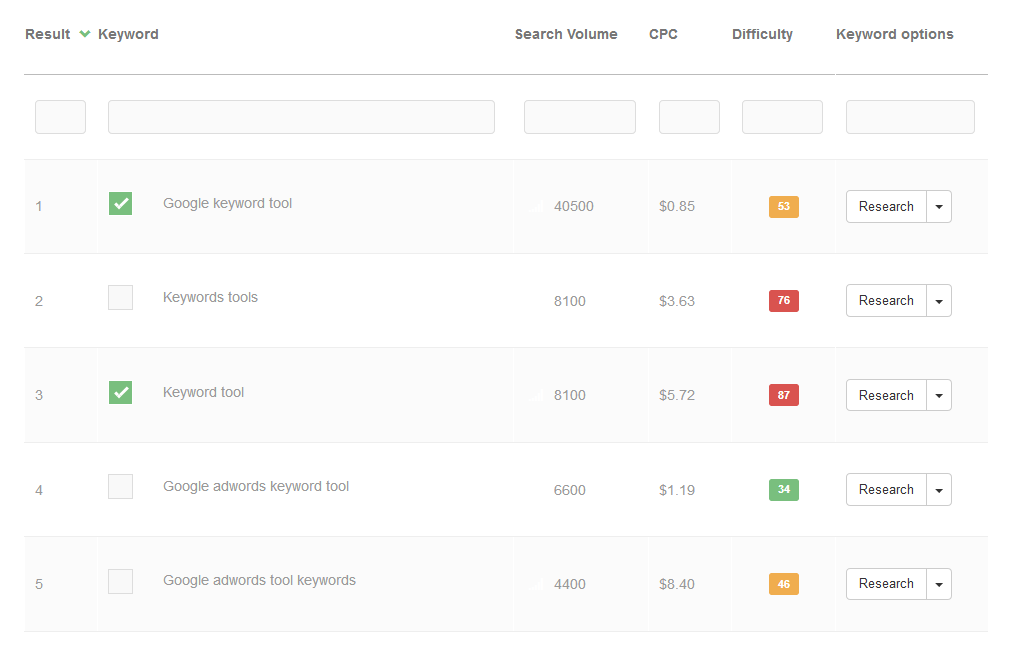
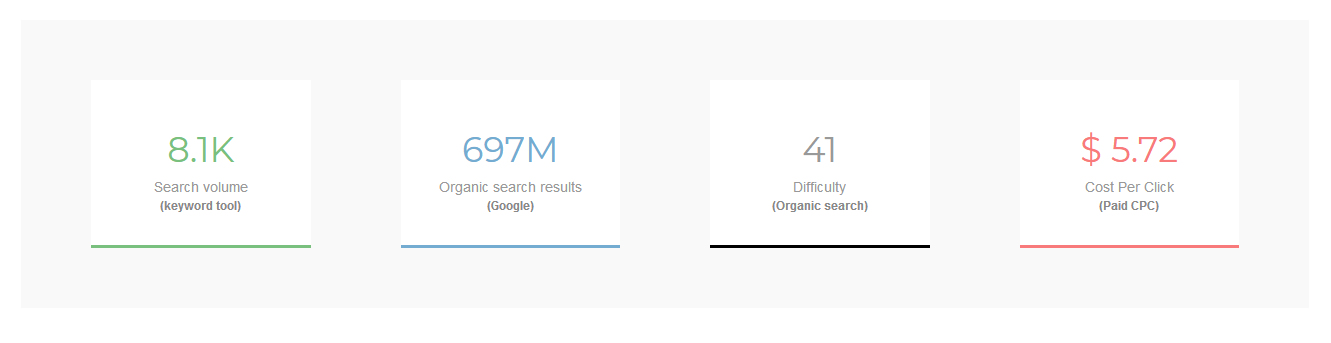
To find keyword opportunities and to assist you with your keyword selection process the Keyword Research Tool collects and analyses:
- Monthly organic keyword search volume
- Total organic search results, based on Google search results
- Keyword difficulty score, an estimate of how difficult it is to rank for this specific keyword
- Average Cost Per Click (CPC), based on Google Keyword Planner
- Related Keyword suggestions:
- Primary keyword suggestions
- Secondary keyword suggestions
- Synonyms and related keywords
Why is keyword research important for SEO?
Keyword research is an important part of SEO, because it will help you to understand the interests of your customers. Based on this knowledge, you’re able to identify keyword opportunities in your industry that will help you to write successful online content. By doing your keyword research the right way, your able to have a positive impact on your content performance. Translating into higher rankings, better content engagement and a higher conversion rate.
Tip: use the SEO writing assistant, to create a great piece of SEO optimized content.
Related Tools and API
- Keyword API – Get keyword statistics at scale and automate your research.
- Google Keyword Research sheet – Use Google sheets + the API to get unlimited keyword ideas.
- Content idea generator – Get writing inspiration for your keyword theme.
- SEO writing assistant – Just focus on writing great content and the assistant will tell you, your SEO score.
- Rank checker – Check how well your content is ranking in Google (multi language support).
































 Get the new Chrome Extension!
Announcement: Starting June 1st, the maximum number of keyword suggestions will be reduced from 100 to 50.
Update: Improved keyword data accuracy.
Update:
Hi Jasja,
I was able to get the tool to work using a screen reader.
I found an issue that i want to report:
the keyword research tool does not produce any results when the word ‘company’ or ‘agency’ is included.
in my case, i tried ‘cleaning company Pennsylvania’, digital marketing company, and cleaning company, and ppc management agency.
if you include company or agency in the search the tool will not produce any results.
(this is the same for the google suggestion tool.
not sure if anyone else has noticed this issue.
thank you-
Hi Elunikow,
Thank you for your feedback, I’ll do some further investigation and get back to you as soon as possible.
Jasja
Hi Elunikow,
Just did an update to fix this issue.
Please try the tool again!
I cannot get the keyword research 2.0 tool to work for me.
when I try to search for ‘cleaning services’ I get the following in the results page:
‘Sorry, problems connecting to the API, please try again after 5 minutes…’
this has been happening for the last several hours.
Any ideas on how I can get around this issue?
Thank you
Hi Jorge,
Yesterday the site was suffering a little bit under the high number of visitors, but today the tool should be working without any issues.
Cheers,
Jasja
Update:
Hi there,
Thanks for your tools for SEO, it helped me a lot.
if your tools could search the keywords in Amazon.com. That will be great, this is a huge demand for Amazon keywords.
HI LC,
Thanks for the feedback ;-) An Amazon Keyword tool is actually already on the roadmap an coming soon!
Cheers, Jasja
The Amazon keyword tool is now also available: https://www.seoreviewtools.com/amazon-keyword-tool/